
HSBC × StashAway:
FPX Collections in Malaysia
How StashAway Malaysia enhanced collections with HSBC — Acme as the third-party integrator delivering real-time deposit feeds through one API. HSBC-published.


StashAway wanted more payment options and faster deposit processing in Malaysia. Direct debits and other methods could take weeks to set up and it leads to friction for investors.
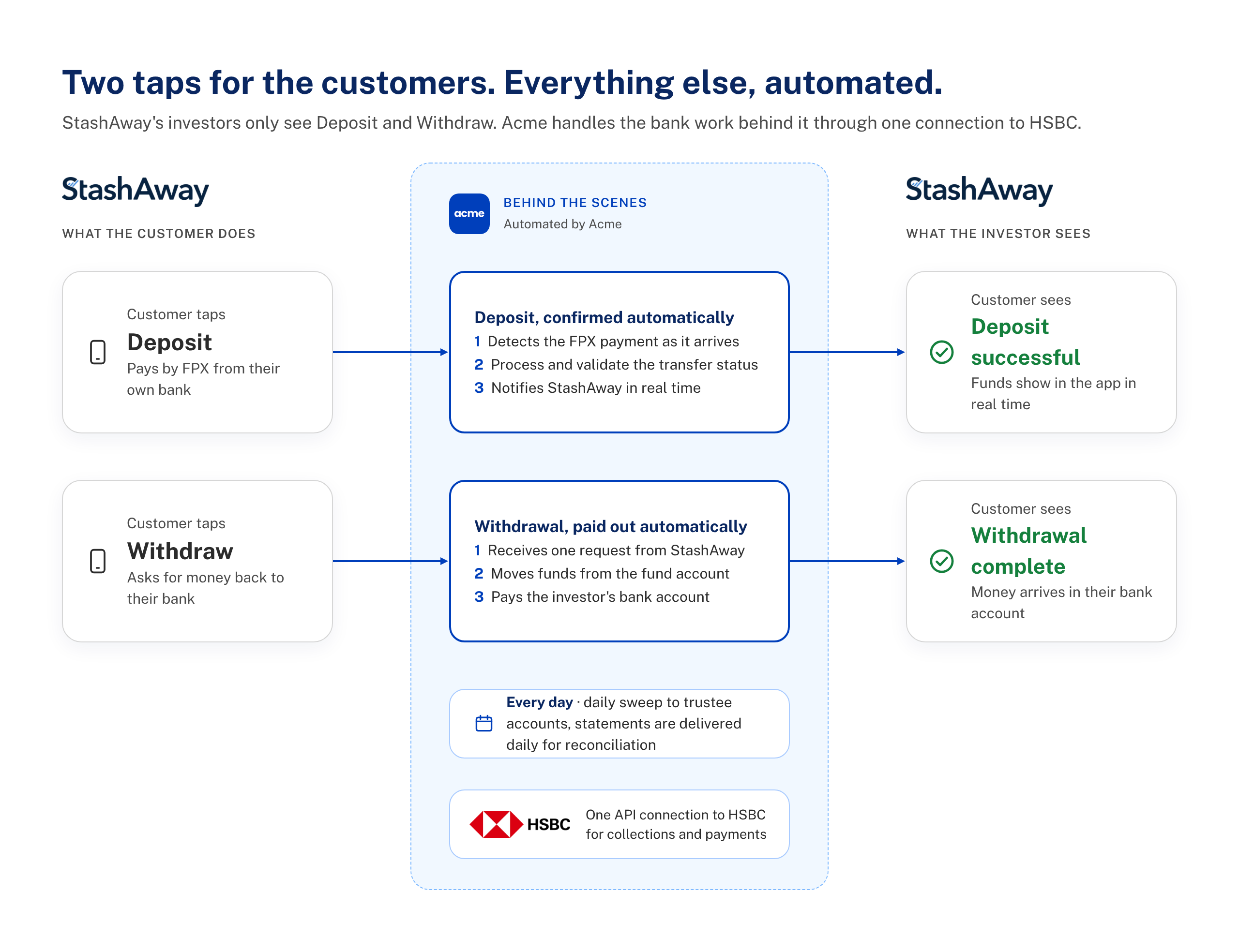
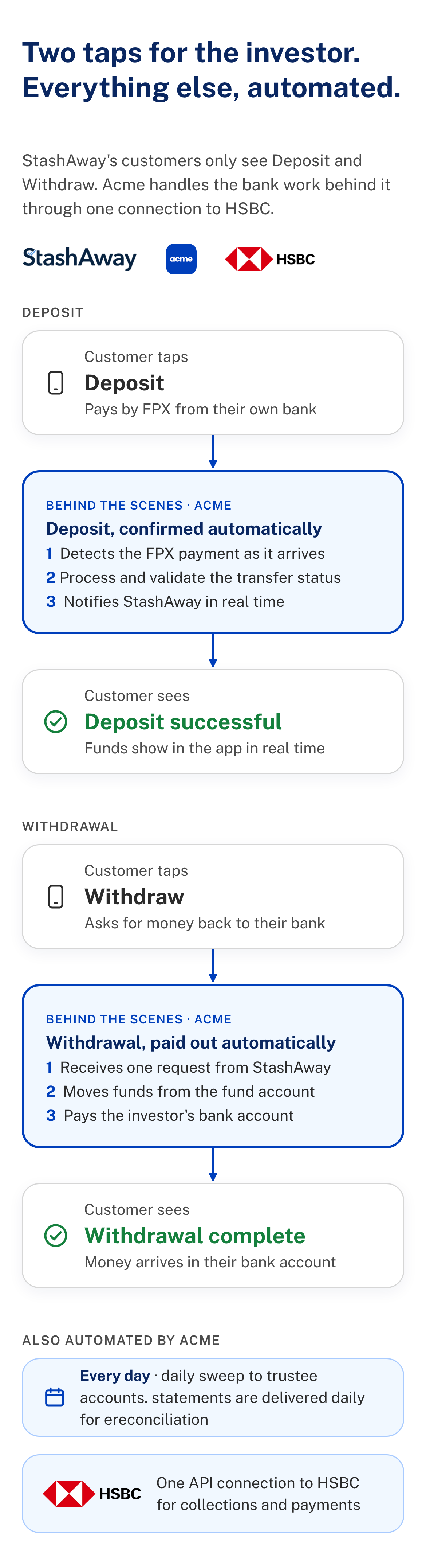
StashAway partnered with HSBC as its lead payments and collections partner. Phase one used HSBC's Omni Collect for FPX (Malaysia's real-time bank-transfer gateway), with a custom workflow that pulled transaction details and integrated HSBC's Transaction Enquiry APIs for real-time push notifications on deposit credit. In phase two, Acme was engaged as the third-party integrator — using pre-integrated connectivity schematics to establish real-time data feeds through a single API connection, so StashAway managed deposits and withdrawals seamlessly through the migration.
Who does the heavy lifting?
Connecting to HSBC in a new market: build it yourself, or let Acme handle the bank work end to end.
- Bank onboardingYOU chase the bank through onboarding and paperwork
- Account opening & API accessYOU work out the bank's requirements for both
- Bank documentationYOU decode the specs and connection method
- Next marketYOU start again with a new bank and new specs
- After go-liveYOU handle bank quirks, data processing and support
 Integrate with Acme
- Bank onboardingACME implementation team runs the project from onboarding
- Bank integrationACME real-time deposit feeds through one API
- TestingACME test-mode environment lets you start testing early
- Next marketACME reuses the same API for every new market
- After go-liveACME handles data processing, bank quirks and support queries
You focus on your product. Acme takes care of the plumbing: mapping, pre- and post-processing, and keeping operations running.
“We operate in some of Asia's fastest-moving digital markets, which pushes us to continuously innovate and improve how people invest.”
“HSBC's investments into its APIs have made it easy to embed the bank's services onto the Acme bank connectivity platform.”
“Malaysia's shift towards cashless payments is creating strong growth opportunities for digital-first businesses like StashAway.”
As published by HSBC, June 2026 · Read the original on HSBC Malaysia